OLD WEST SWAGGER

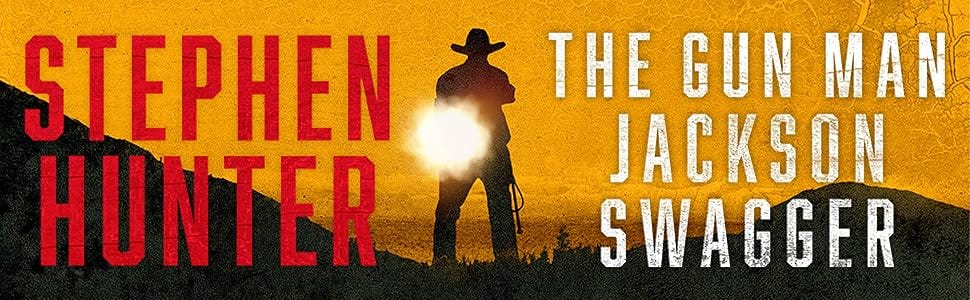
Since 1993, Stephen Hunter has written twenty novels about the Swaggers, a Scottish-American clan whose firstborn son always inherits a preternatural facility with deadly weapons, particularly guns of just about every kind. Hunter, who won a Pulitzer Prize for the film criticism he wrote for The Washington Post, has also written a half dozen standalone novels, a film novelization, and three nonfiction books. His latest novel, published in October, is The Gun Man Jackson Swagger, and it is his first Western novel (though most of his novels have a sort of Western vibe, thanks to the Shane-like loner gunman at the center of each story). This book, though the newest in the saga, is chronologically the first of the Swagger novels. Hunter has written two novels about Jackson’s son Charles Swagger, both set in the 1930s, four novels about Charles’s son, Earl Swagger, all of them set in the 1940s, twelve novels about Earl’s son Bob Lee Swagger, who is the main star of the series and whose exploits span from the Vietnam War to the present day, and two novels about Ray Cruz, Bob Lee’s son, who is featured in two novels set in the present day. I haven’t read all twenty books in the series, and I haven’t been crazy about all of the ones that I have read, but several of them have been outstanding. My favorite Stephen Hunter novel is Dirty White Boys, published in 1994. Only tangentially linked to the other books in the series, it can be read as a standalone. My second favorite is Hot Springs, published in 2000 and the first book in the Earl Swagger series. The Gun Man Jackson Swagger isn’t quite as good as those two, but it is a worthy addition to Hunter’s bibliography as well as to the canon of novels about the American West.
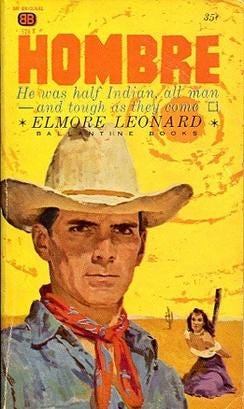
Like most of Elmore Leonard’s Western novels, The Gun Man Jackson Swagger is set in Arizona. And like most of Cormac McCarthy’s Western novels, it is set near the Mexican border, with action that regularly takes the characters back and forth across that border. For much of the book, Hunter seems to be channeling both of those novelists. Fortunately, he leans more towards Leonard than McCarthy. The writing, like McCarthy’s, has too many faux Biblical passages and direct Biblical references for my taste: “While most of America prospered in the wonderful year of 1897, here vegetation turned brittle while the once abundant variegated cacti had retreated within themselves, their spindly arms forming structures more appropriate to crucifixion than blossom. Every hillock was its own Golgotha.” But for every passage of priestly purple, Hunter gives us ten or more of laconic, Leonard-esque minimalism: “The bullet hit him square in the head. It wasn’t pretty. It never is.” In an author’s note at the beginning of the book, Hunter name checks Glendon Swarthout’s classic Western The Shootist, and that book also seems to have been a major influence. At the back of the book, Hunter cites “Kobayashi’s great film Harakiri” as the inspiration for his plot. Having never heard of that film before, I can’t comment on its influence. But the book is dedicated to: “John Wayne, John Ford, Jimmy Stewart, Gary Cooper, Sam Peckinpah, William Holden, John Wayne [not a typo on my part], Lyle and Tector Gorch [presumably this is a reference to The Wild Bunch and not Buffy the Vampire Slayer], Sergio Leone, Clint Eastwood, Richard Boone, James Arness, Jock Mahoney, and John Wayne.”
While this is a Western novel, it is also much more than that. It is a mystery novel and a spy thriller as well. As the novel opens, Jackson Swagger is about sixty years old. A native of Arkansas, he fought for the Confederacy in the Civil War and has made a living as a hired gunman in the years since. He is so good at what he does, that he once allowed a New York journalist to follow him around and write about his exploits. The journalist produced a piece of pulp reportage called The Gun Man Jackson Swagger, a true but heavily exaggerated account of Swagger’s most daring exploits that became a runaway bestseller, making it difficult for Swagger to travel incognito.
Early in the novel, Swagger shows up at a massive cattle operation called The Callahan Ranch and seeks to hire himself out as a gunman. The cattle ranch hires two types of men: cowboys and gunmen. The cowboys carry no weapons and concern themselves almost exclusively with the driving of cattle. The gunmen protect both the cowboys and the cattle on long drives. When cattle aren’t being driven anywhere, the gunmen ride the perimeter of the enormous ranch looking for rustlers to shoot and kill. Tom Voth, Colonel Callahan’s top gunman, is dubious when Swagger first asks him for a job. Gun-fighting is generally a young man’s game and Swagger clearly has a lot of mileage on him. Still, Voth sets up a test of Swagger’s gun skills and, when Swagger (naturally) dazzles him with his precision and speed, Voth gives him a job.
Fans of Stephen Hunter know that one of the highlights of his novels is Hunter’s passion for guns. No thriller writer alive writes more poetically or passionately about weaponry and he can wax poetic for pages on end about the small details of a particular gun or a particular brand of ammunition. The Gun Man Jackson Swagger contains plenty of this waxing. Here he is describing the Colt Special Targets, a lesser-known variation of the famous Colt Peacemaker:
“To any of the thousands of Westerners familiar with Colt’s most famous product, the Peacemaker, this one would have seemed odd. Perhaps an ancient thunder lizard had taken a Peacemaker in the jaws and crushed it or possibly the beast stepped on it. It boasted the famous Peacemaker lines, legendary since 1873 for grace, as well as near-on-perfect comfort to hand, but those lines had been squished – squashed? crushed? – from top to bottom, and it appeared to have collapsed upon itself. It was less tall, more squat. It was not particularly beautiful the way its progenitor was. For one thing, the barrel, forced downward, was much closer to the trigger guard, and being compacted, it facilitated recoil directly into the hand and forearm and did not compel the revolver to leap upward on the shot, as had the original.
“Too, the grip, so fluid in the original, had a harsher bend to it, curling more relentlessly groundward. For another thing, instead of the traditional three humps of hammer channel, hammer pivot, and grip, which precisely reflected one another and gave the original a lyric melody in steel, it appeared that one of the three had been squeezed out, permitting only two in the reduced real estate available, with the pivot now directly a part of the grip. Then again, the hammer, a proud and stately statement of curvature and pride that seemed to reach for the sky, was in this iteration much stubbier, much softer in effect, and much lower. It held no sharp angles to cut the skin. Thus, uncut, it could be reached by a thumb, without the hand quitting the grip. And finally, the trigger guard, another masterpiece of grace and rhythm in the antecedent, had been lengthened into something almost ungainly.
“Of course, the Colt people had committed these desecrations not out of madness but out of measure, carefully considered. The stated reason was to improve Colt’s success in the world of target shooting, particularly at the big pistol match held at Bisley, England, every year. The lower barrel and straight-back jump of the recoil impulse made recovery quicker and more sure. The sharper angle of the grip enabled the one-handed shooter to secure it more firmly in a position accessible to the unblinkered eye. The lowered hammer spur meant, as stated, less stretch in the cocking, hence less disturbance to the iron grip in which the pistol was secured, and the more spacious trigger oval gave the target shooter room to stretch his finger against the onset of cramps.
“In this regard it was certainly a success, as Bisley records showed, but in so doing the Colt engineers had also fashioned the best fighting pistol of the age. Everything that made it a better target gun also made it a better fighting weapon in general, easier and faster to handle. Particularly in its shortest barrel length, 4 inches, as was Jack’s, it was superb out of the holster and into an instant shooting position, and the softer hammer made it a surer instrument for slap-firing. The bigger trigger guard opened it up to the leather gloves so common to the frontier. A skilled man could really rip with it, and Jack was skilled.”
The passage goes on to describe at length the holsters in which Jackson Swagger’s Special Targets pistols are held when not in use as well as the ammunition used in the Colt (Remington .38-40s). When Jackson loads the weapon, we are told that he always leaves the first of the six chambers empty. “Anyone knowledgeable of the revolver did this because a design flaw that Colt hadn’t been able to overcome meant that when the gun was loaded with six cartridges, the firing pin rested on the explosive primer of a live round, which set up an accidental gunshot off a bump or a fall or a drop that banged the hammer, which would bang the pin, which would bang the leg or whatever else lined up with the barrel. The loading protocol allowed the firing pin to rest on the air of an empty chamber. Cocking put the gun in action for five quick shots. If a fellow expected gun trouble, he might then add a sixth round to the instrument, preferring the extra firepower to the measure of safety. It was always, however, a dicey decision.”
I have never owned nor fired a gun but even I get a thrill out of reading Stephen Hunter’s writings about guns. Still, I have to say that, lately, his paeans to the gun have begun to border on self-parody. I once heard John Irving say that, “In the end, a writer’s greatest strengths often become his greatest weaknesses.” That certainly seems true of Irving himself, whose determination to out-Dickens Charles Dickens has caused a lot of his later novels to become overly convoluted of plot and heavy-handed in their efforts at comic effect. Hunter hasn’t completely gone overboard in his adulation of weaponry but he does push his enthusiasm for the subject to extremes at times.
Fairly early on in The Gun Man Jackson Swagger it becomes clear that Swagger didn’t sign up to work for the Callahan Ranch because he needs the money or the work. He’s there to investigate some matter that only gradually reveals itself to the reader. As the story progresses we see that the Callahan Ranch isn’t just another cattle operation. In fact, it appears to owe its success to the railroad business more than to the cattle business. Every month or so, Colonel Callahan sends a team of cowboys and gunmen into the northern Mexico city of Agua Caliente to exchange cattle for supplies. His contact in Mexico is a crooked Mexican Army officer named Major Arau. This crook supplies the Callahan Ranch with supplies he has stolen from Mexican Army storehouses. Arau is so crooked, that he also sends out men who will try to rob the Callahan team as it returns to Arizona with its ten wagons fully laden with supplies. Every few months, the Callahan crew travel to Mexico with eleven wagons rather than ten. The tenth wagon will bring back a top secret cargo. Colonel Callahan likes and admires Swagger but he doesn’t want him knowing anything about the eleventh wagon. So when the crew take eleven wagons to Mexico, the Colonel generally finds something else for Swagger to do. Naturally, that eleventh wagon is an integral part of the mystery that Swagger is investigating.
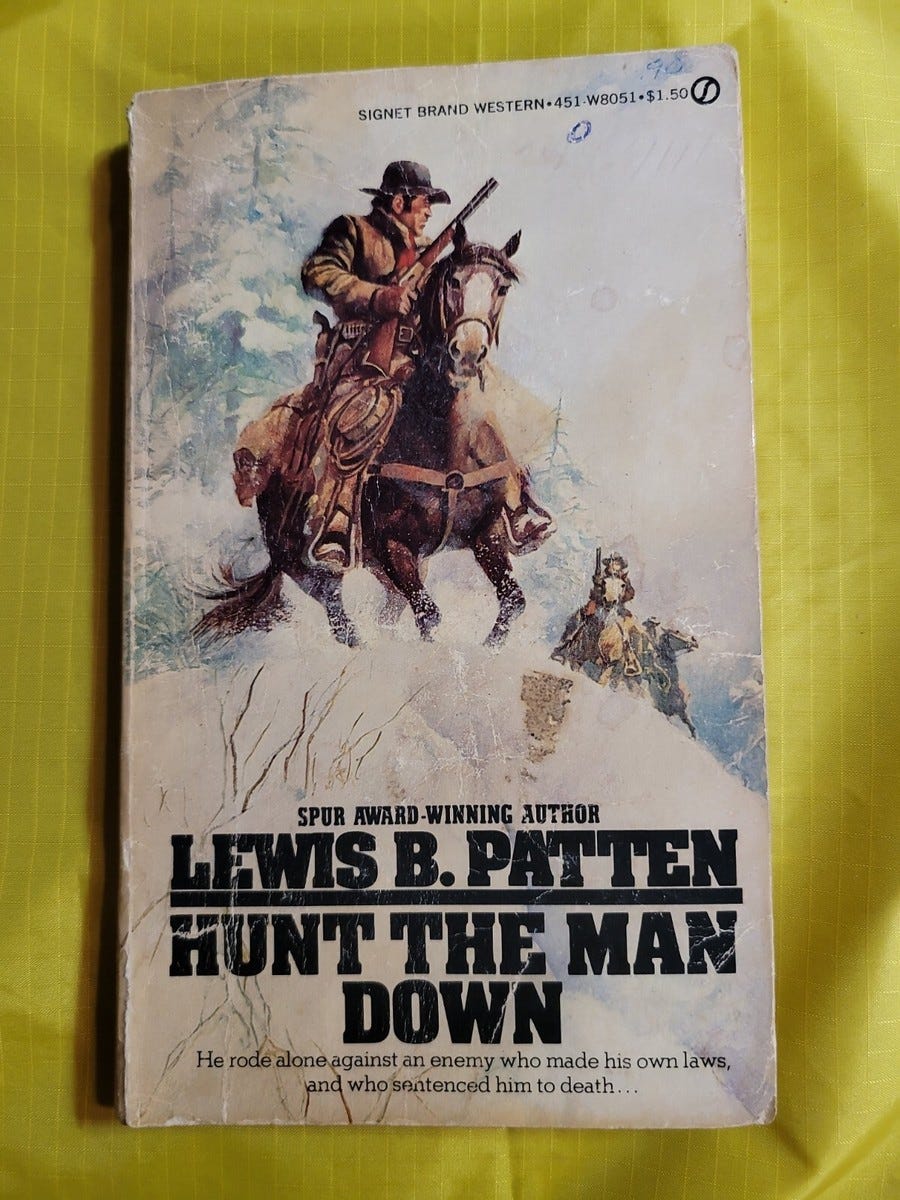
Another, connected, branch of the plot involves a Marxist revolutionary known as “The Frenchman,” who is training up a guerilla army with which he hopes to overthrow the American Capitalist system (good luck with that). The Frenchman’s path will intersect fatefully with Swagger’s. For a novel of only 288 pages, The Gun Man Jackson Swagger packs in a great deal of plot and incident in between its rhapsodies to guns and ammo. Naturally many of those incidents are violent and bloody. The characterizations seemed a bit thin to me. And the descriptions of place were poetic without being very evocative. Writers like Elmer Kelton, Louis L’amour, and Lewis B. Patten, all of whom grew up in Western landscapes, generally did a better job of describing the terrain and animals and weather of the West than Hunter does here. Even Elmore Leonard, who grew up in Detroit, does a better job of evoking Western landscapes in his Westerns (although much of what he knows about the Old West he learned from reading back issues of Arizona Highways magazine). Hunter was born in Kansas City, Missouri, but he came along a good generation or so after the births of Leonard, Kelton, L’amour, and Patten.
But when it comes to violent death, Hunter is as good or better at describing it than almost any other thriller writer. His father, a university professor, was murdered in 1975 by two male prostitutes, which may have something to do with Hunter’s fixation on violent death in his novels. In any case, if you grew up jonesing on books like Shane and Hondo and The Shootist and Hombre, you will almost certainly enjoy The Gun Man Jackson Swagger. I certainly did.