NIGHT OVER WATER

Warning: This review contains spoilers for an 86-year-old film and a 35-year-old novel.
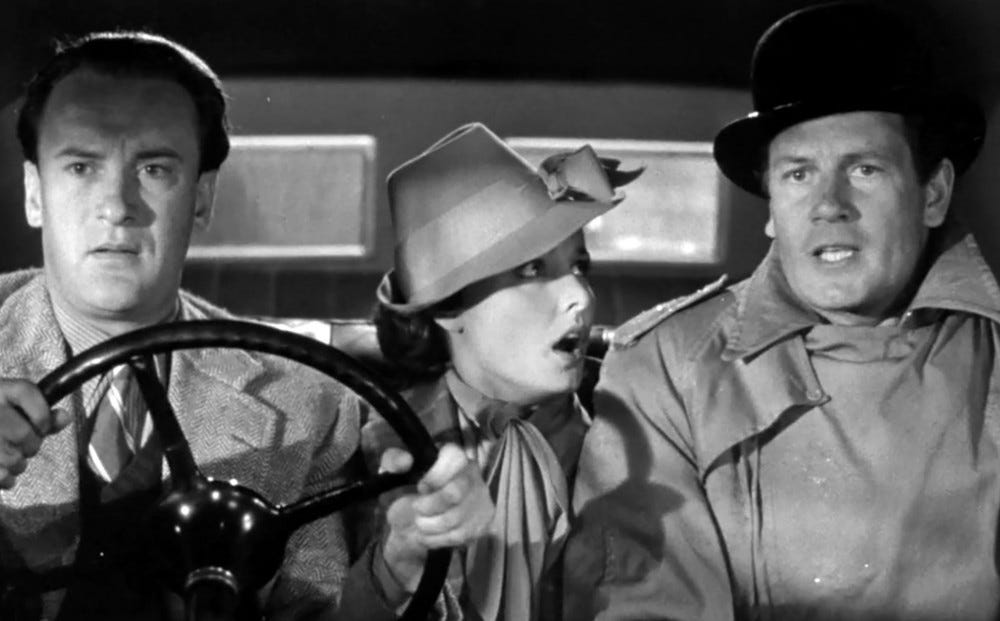
Last weekend my wife and I watched Alfred Hitchcock’s 1940 World War II thriller, Foreign Correspondent, for the first time in decades. All my wife could recall of the film was that it involved windmills. All I could recall was that it involved the crash landing of a passenger airplane in the Atlantic Ocean. The film stars Joel McCrae as an American journalist trying to expose a phony European peace organization that is actually a hotbed of Fascists. Herbert Marshall plays an upper-crust British Fascist trying to escape to America ahead of the Nazi invasion of Great Britain. The story begins in the final days of August 1939 and ends on September 3rd with the German invasion of Poland and the outbreak of World War II.
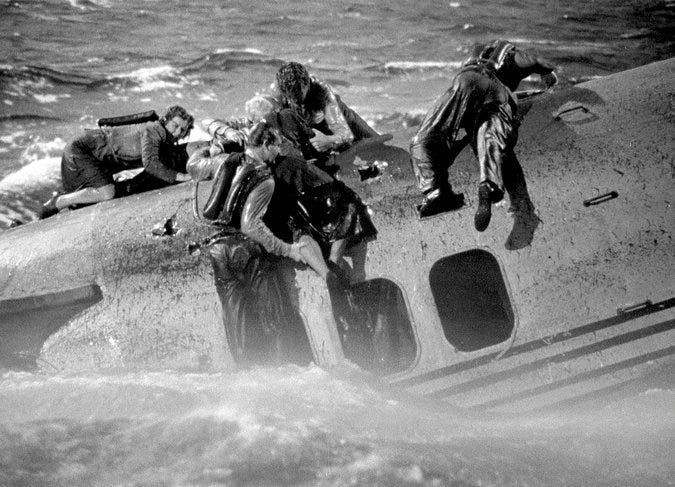
My wife and I both enjoyed seeing the film again. I had forgotten that the plane that crashes into the ocean was a Pan Am Yankee Clipper, one of the most storied passenger airplanes of all time, despite the fact that it was only in service for a few weeks. The Clipper was actually a flying boat. It had no landing gear. Prior to World War II not many airports had runways to accommodate extremely large passenger planes, so there was no point in making such planes. Pan Am had Boeing make the Clipper a flying boat, so that it could land on the water. From Southampton, in England, it flew to Foynes, an Irish seaport. From there it flew to Botwood, in Newfoundland, Canada, where it refueled before heading south to New York. In each port, it landed on the water. A small motorboat would zoom out to attach cables to the rear of the plane, and then the plane would be hauled backwards, via a winch, to a nearby dock, where passengers could depart. I’ve always been fascinated whenever I’ve come across references to the Clipper, but I had never before bothered to look into the legendary ship.
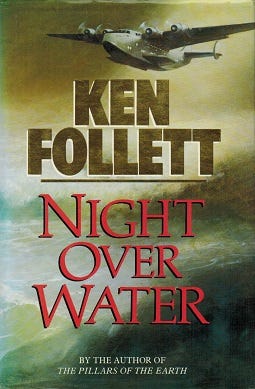
After watching Foreign Correspondent, I remembered that, for twenty years or more, I have had a copy of Ken Follett’s 1991 novel, Night Over Water, sitting on my bookshelves. I bought it years ago, probably after a previous viewing of Foreign Correspondent, but I had never read it. All I knew about the book was that it was a fictional account of the last flight of Pan Am’s Yankee Clipper. So, I dug out Follett’s novel and decided it was time to finally read the damn thing. In fact, I began reading it just an hour or so after watching the Hitchcock film.
In many ways, the book reads like a sequel to the film. I feel confident that Follett took a great deal of inspiration from Foreign Correspondent. Both the book and the film feature a wealthy British fascist with a beautiful (non-fascist) daughter (played by Laraine Day in the film). The film ends on September 3, 1939. The book begins on September 3, 1939. The film includes a character (a MacGuffin, actually) who is a brave Dutch diplomat trying to undermine the Nazis. The book contains a brave German physicist whose is trying to escape Europe for America so that the Germans can’t force him to design bombs for them. Near the end of the film, many of the main characters depart England aboard a Yankee Clipper. Near the beginning of the novel, all of the main characters depart England aboard a Yankee Clipper.
Both the book and the film are hugely entertaining. The best thing in the film is George Sanders’s performance as sardonic British journalist Scott ffolliott. Alas, the novel has no character anywhere near as amusing as ffolliott (curious that a man named Follett couldn’t create his own ffolliott). Both the film and the book are shamelessly melodramatic. The film was written by Joan Harrison and Charles Bennett. But much of the dialog was written by James Hilton (the Ken Follett of his time, Hilton wrote the first great paperback bestseller, Lost Horizon) and Robert Benchley (a New Yorker contributor known for his wit, Benchley also acted in this film, as well as many others). The plot of the film frequently relies on silly contrivances, but the sparkling dialog by itself is worth the price of admission. Follett’s novel doesn’t have much in the way of sparkling dialog. The characters all seem to have stepped out of a 1930s film. Follett acknowledges this himself. One of the characters, a wealthy American businesswoman named Nancy Black, tells a traveling companion, “I feel like a character in a motion picture, acting out a scenario that was written by someone else.” Everyone else in Night Over Water also seems to have wandered in from a Hollywood backlot: a jewel thief, a Nazi spy, an undercover Scotland Yard detective, an undercover FBI agent, a movie starlet, a film producer, a British business tycoon, an American gangster, and so forth.
But stock characters and loads of melodrama can still add up to a great deal of pop-fiction pleasure, and they certainly do so in Night Over Water. Follett has several things going for him that Hitchcock didn’t. For one thing, Hitchcock had no real interest in the Pan Am Clipper. Follett seems to be one of the few pop-culture mavens to realize just how interesting the story of the Clipper really is. In Follett’s hands, the Clipper becomes nearly as fascinating as the RMS Titanic or the Hindenburg. Follett’s opening line is simple but memorable: “It was the most romantic plane ever made.” And he spends the next 525 pages convincing us that he is right. Another advantage for Follett is that he cares a lot more about his plot than Hitchcock, who liked to ratchet up the suspense but often did so at the expense of believability (why didn’t Lars Thorwald simply close his window blinds when cleaning up after his wife’s murder in Rear Window?). Night Over Water is filled with over-the-top moments of derring-do and hair’s-breadth escapes and wild coincidences, but Follett never completely throws logic to the wind. Among a multitude of other crimes, the book contains a kidnapping plot that made me roll my eyes. I have complained before about how fictional characters, when told by someone holding their loved one for ransom, “Don’t go to the police or your wife/daughter/father is dead!” almost never go to the police. Of course, the kidnapper doesn’t want you to contact the police. The police are trained to catch criminals! That’s why your first call should be to the police! Follett deployed this same old trick. But it made even less sense than usual this time. Kidnappers in America, telephone Pan Am employee Eddie Deakin, a member of the Clipper’s flight crew, in England, and tell him that they have kidnapped his wife in America. Then they inform Eddie that unless he forces the captain of the Clipper to make an unscheduled water landing south of New Brunswick, they will kill her. Eddie is at least 24 hours from America by air. If he were to call the police back in his American hometown and report his wife’s kidnapping, they could be looking for her immediately. Instead he decides to play along with the kidnappers in the hope that he can foil their plan when he reaches America. What’s more, he keeps the whole thing secret from the pilot and the rest of the crew. He puts about 100 lives at risk by purposely bleeding off fuel from the engines so that he can inform the captain that they will have to make an emergency landing in a calm inlet where the kidnappers are waiting to board the ship for reasons unknown to Eddie. (Despite being a big boat, the Clipper cannot land on rough waters. It needs to land on relatively flat water. If it landed on choppy water it would break apart, just as a 747 would if it landed on a harshly undulating surface.)
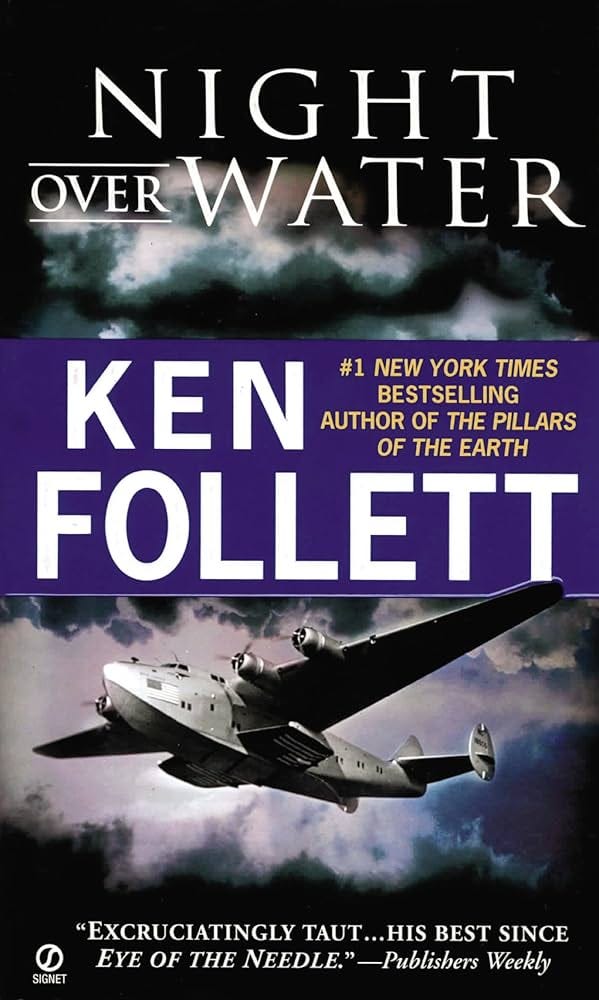
Despite the occasional eye-rolling plot twist, I was fully on board Follett’s ship for the whole ride. He wasn’t striving for the journalistic realism of, say, Frederick Forsyth’s Day of the Jackal. It’s clear that his primary model for Night Over Water was the (equally far-fetched) work of Agatha Christie, particularly the novels Murder on the Orient Express and Death on the Nile (or, more likely, the 1970s film versions of them). In fact, Follett at one point compares flying on the Clipper to traveling down the Nile by boat or across Europe on the Orient Express. If you read the novel in the same spirit as you would watch Albert Finney in Murder on the Orient Express or Peter Ustinov in Death on the Nile, you will have a great time. Night Over Water isn’t as witty as those films are, but it is filled with excitement, amusing characters, interesting locales, sudden reversals of fortune, unpredictable plot twists, and so forth.
Somewhere there is probably a great non-fiction history of the ill-fated Pan Am Clipper. But even if you can find that book, it probably won’t be as entertaining as Follett’s novel. And his novel is filled with fascinating information about the most romantic plane ever made. Pan Am ordered twelve of them from Boeing (technically the ship was known as the Boeing 314). Only six were made. They were first put into service in August of 1939. A few weeks later, the outbreak of World War II caused the airline to pull them from service. They were turned over to the U.S. military and dismantled for parts. No surviving models exist. Foynes, Ireland, is the home of a Flying Boat museum that houses a full-scale mock-up of the Boeing 314. That’s as close to a real one as you can get in the physical world. But the best way to learn about the Clipper is via Ken Follett’s imagination, and your own, by reading Night Over Water.
I trust that Follett got all of the details about the Clipper right in his book. He did the research back in the 1980s, when there were still people alive who had flown aboard a Clipper. Even some of the old crewmembers were still alive for Follett to interview. He lists a number of resources that helped him find info about the Clipper. Alas, not all of his historical touches are as well researched as the airplane. At one point, a character imagines herself “in an Art Deco apartment, all windows and mirrors…” Art Deco was everywhere in the 1930s, but no one back then called it Art Deco. That term was coined in the 1960s and didn’t become widespread until the publication of a book on the movement published in 1968 and written by Bevis Hillier. Prior to that it went by a variety of names – streamline moderne, jazz moderne, style moderne, zigzag moderne – but no English speaking person in the 1930s would have referred to it as Art Deco (this is a fairly common error in novels set in that era).
If you are squeamish about sex, you may want to give Night Over Water a pass. Though inspired by Agatha Christie, Night Over Water was written at a time when smutty novels by the likes of Jackie Collins and Harold Robbins and Judith Krantz were dominating the bestseller list. Understandably, Follett fills his book with so much graphic sex that a good alternate title might be Fucking in the Fuselage.
To Follett’s credit, he seems to be improving with age. His 2021 thriller, Never, a scarily believable tale about how World War III might break out, is probably the best of the Follett novels I have read. Night Over Water may not be the best Ken Follett novel, but it is probably the best piece of pop culture we’re ever likely to get from the brief but fascinating life of the Pan Am Yankee Clipper.