FOLLETT'S FIRST FIVE

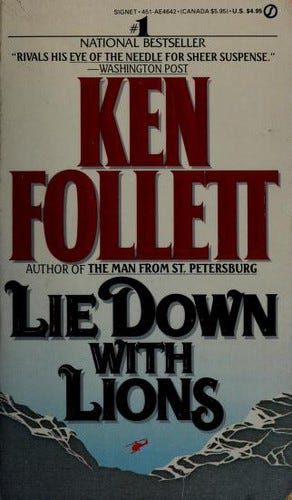
Despite my good intentions, I rarely complete any of the ambitious reading projects I set out to accomplish each year. One of this year’s projects was to re-read Ken Follett’s first five bestselling novels and see how they compare to my memory of them. Those five novels are Eye of the Needle (1978), Triple (1979), The Key to Rebecca (1980), The Man From St. Petersburg (1982), and Lie Down With Lions (1986). These books are especially important to me because Ken Follett was the first author that my avid-reading wife and I shared a mutual interest in when we first got together. We read each of those first five bestsellers (Follett had published about ten non-bestsellers prior to the publication of Eye of the Needle) usually as soon as they appeared in paperback. I have long wanted to see if these books were as special as I remembered. Miraculously, I have just finished re-reading Lie Down With Lions, which means that I actually completed a five-book reading project that I set for myself earlier in the year. That almost never happens!
My recollection of those early days of Kevin and Julie and Ken is that, though they liked all of Ken’s first five bestsellers, Kevin and Julie felt that none of the subsequent four novels was ever quite as good as Eye of the Needle. And this may have had something to do with why Kevin and Julie drifted apart from Ken after reading Lie Down With Lions. The timing was a bit of a shame, because Ken’s very next novel, 1989’s The Pillars of the Earth, would become his biggest bestseller and one of the bestselling novels of all time. According to Google’s AI: “Ken Follett’s The Pillars of the Earth is widely regarded as an all-time bestseller. The novel has sold more than 26 million copies worldwide and ignited a massive resurgence in the historical fiction genre…It spent years at the #1 spot on various international bestseller lists, including six years on the German bestseller list.” Julie would eventually read (and love) the book around 2009, about twenty years after it was published. Kevin, to his shame, hasn’t read it yet, but he has an ambitious plan to read (or re-read) all of Follett’s fiction over the next year or so.

For now, however, it is time to revisit those first five bestsellers and see how well they have held up in the nearly fifty years since the first of them was published. I have already reviewed four of those five novels over the course of the past few months. I don’t plan to do a detailed review of Lie Down With Lions here but I will give you a brief rundown of its pros (many) and cons (if any).
When Follett published LDWL, in 1986, its subject, the Soviet-Afghanistan war (1979-1989), was still raging. This was the first of his bestsellers that was not a historical work. The previous four included a novel set at the outset of WWI, two WWII thrillers, and a novel about Israel’s efforts, in the late 1960s, to obtain an atomic weapon. I am not a fan of dreary war news (who is?), and the Soviet-Afghanistan clash had been all over the news for seven years by the time LDWL was published. The Soviet invasion of Afghanistan was the reason that U.S. President Jimmy Carter forced the U.S. Olympic team to boycott the 1980 Olympics. The Soviet-Afghanistan war was fraught with war crimes and the newspapers of the day were filled with stories about young Afghan children who had picked up what they thought was a toy lying on the ground only to have their hands blown off by a Soviet landmine. Thus, although I dutifully purchased a copy of LDWL and began reading it, I can’t be certain I ever finished it that first time around. I may have found the whole subject just too bleak.
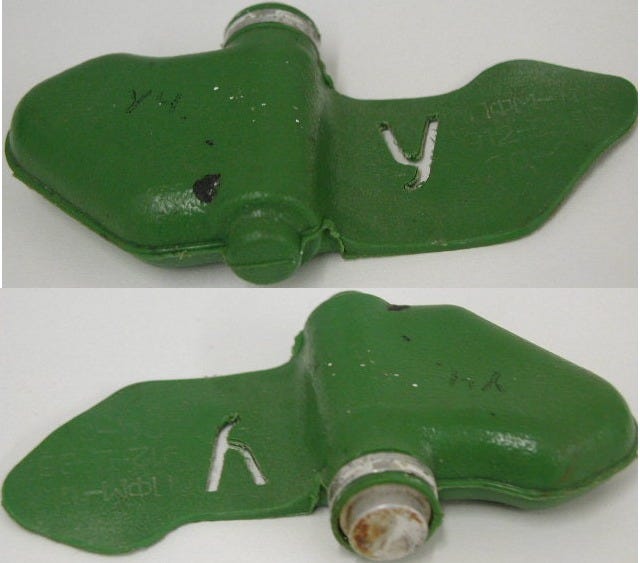
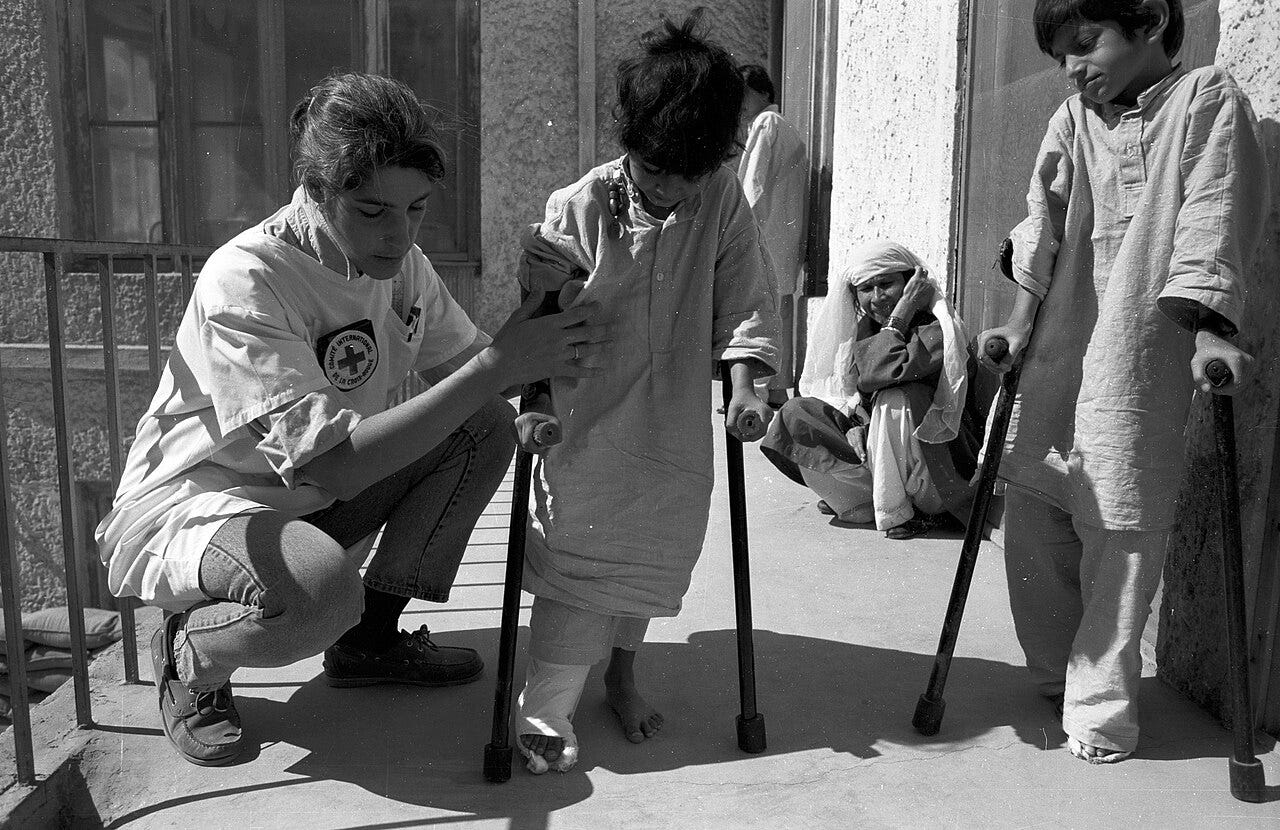
But, nowadays, LDWL is another of Follett’s historical novels. When Follett published Eye of the Needle in 1978, WWII had been over for 33 years. The Soviet-Afghanistan war has now been over for 37 years. LDWL is more of a historical novel now than Eye of the Needle was when I first read it in the late 1970s. The Soviet invasion of Afghanistan (which has some parallels with the current Russian invasion of Ukraine) is still a very dark and dreary subject, but enough time has passed to make it seem safely in the past and not some ongoing crime against humanity (though its repercussions still continue to poison our present world). Perhaps the best thing (or even the only good thing) to come out of the war was that it appears to have directly led to the collapse of the Soviet Union, which, at the time at least, seemed like an unalloyed good for the world. As many as two million Afghan civilians died in the war, and hundreds of thousands of others, many of them women and children, were made invalids by it. Millions more became refugees in Pakistan and other countries. The war contributed to a huge rise in guns, drugs, and jihadism in Afghanistan which persists to this day. This may seem like a tragedy too bleak to inspire any sort of exciting or uplifting work of popular fiction. But the two World Wars were much bleaker and more tragic and they have both produced plenty of thrilling and uplifting works of popular fiction. In the Woody Allen film Crimes and Misdemeanors, a pretentious character played by Alan Alda notes that, “Tragedy plus time equals comedy.” (That’s an old saw that predates the twentieth century). Follett’s Lie Down With Lions demonstrates that tragedy plus time can also equal damn good popular fiction.
The novel begins with a brief prologue set in Paris, in 1981, where an American CIA operative (and Vietnam War veteran) calling himself Ellis Thaler has infiltrated a group of radical leftist terrorists. Ellis is 33-years-old and has a girlfriend named Jane, a British woman, who is ten years his junior. Jane is a medical student whose companionship Ellis first cultivated because, though she was no terrorist herself, she hung out with a very leftwing crowd, young students who actively campaigned against nuclear power, apartheid, and other leftwing bugaboos, and some of these young people were also terrorists. Somewhere along the way, Ellis made the mistake of falling in love with Jane. Through Jane, Ellis has also made the acquaintance of Jean-Pierre, a young French doctor who desires Jane and (secretly) hates Ellis for having won her affections. However, when Ellis sets up a sting operation that lands many of Jane and Jean-Pierre’s leftwing pals in jail, Jane turns against him. She dumps Ellis and marries Jean-Pierre, in large part in order to spite Ellis for his betrayal.
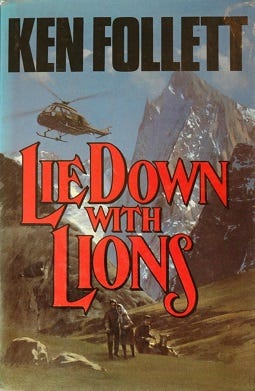
One year later, newlyweds Jane and Jean-Pierre are in the Panjshir Valley (often referred to by Westerners as “the Five Lions Valley”) of Afghanistan, sponsored by an organization that is a fictional version of Doctors Without Borders. Jane and Jean-Pierre are there to provide medical care to the Afghan rebels who are fighting off the Soviet invasion. The newlyweds also look after the wives and children of these freedom fighters. Jane and Jean-Pierre are embedded in an extremely harsh and inhospitable part of Afghanistan (to a Westerner, pretty much all of Afghanistan seems harsh and unforgiving). After about a year’s time, Jane and Jean-Pierre have been largely welcomed into this small Afghan community. Jane is particularly popular because of her kindness and consideration for others. Jean-Pierre likes to play the self-sacrificing doctor who gave up his cushy career in Paris to tend to the poor and beleaguered of Afghanistan, but the local Afghans can see that this is a bit of an act. Jean-Pierre thinks very highly of himself. What’s more, he has an ulterior motive for being in Afghanistan that the locals (and Jane) don’t know about but which the locals, at least, somewhat suspect.
This is a tough milieu, and frequent aerial attacks by Soviet fighter jets and bombers regularly kill or maim both the Afghan rebels and their wives and children. Jean-Paul and Jane have limited medical equipment, but they both do their best to keep the victims of these Soviet attacks alive. Complicating matters is the fact that Jane has recently learned that she is pregnant. This angers Jean-Paul, and he demands that Jane allow him to abort their unborn baby, but she won’t allow it. This creates a rift between the couple, who were already experiencing various marital problems.
Into this hotbed of war and mayhem, Ellis Thaler shows up one day. He has been sent as an emissary of the U.S. government. The CIA and others in the government would like to secretly funnel money to the Afghan rebels to help them fight off the Soviets (any enemy of the U.S.S.R. is perceived during the Cold War era as a friend of the U.S.). But the Reagan administration fears that if they send money and arms to individual Afghan warlords, the warlords will merely waste it by fighting against their ancient enemies in other Afghan tribes. Ellis has been sent to Afghanistan to meet with several of the most powerful rebel leaders, all of whom are from different tribes and don’t get along well with the others, and convince them to work together against the Soviets in order to receive help from the U.S. Ellis wants to organize a peaceful summit between the major warlords and get them all to sign an agreement obligating them to use any material assistance provided by America only against the Soviets and not against each other. This won’t be easy to do because, as noted, the warlords have longstanding grudges against one another. One warlord may have caused the deaths of another warlord’s beloved brother, or son, or father. Ellis knows that his mission will be nearly impossible, but he is determined to pull it off.
Neither Jane nor, especially, Jean-Pierre is happy to see Ellis again. Although they know that the U.S. would sincerely like to see the Afghan rebels win the war with the U.S.S.R., they still don’t trust either Ellis or the CIA. Jane and Jean-Pierre consider the CIA to be the world’s biggest terrorist organization. Nonetheless, Ellis manages to convince at least Jane that American support for the Afghan rebels will be a boon for the people whose lives she is trying to save. Jean-Pierre, for reasons of his own, isn’t buying it. He wants Ellis dead. And at one point, he will get an opportunity to kill Ellis himself.
To demonstrate how useful American arms can be, Ellis has brought TNT and other explosive materials with him to Afghanistan. In one scene, he leads Masud, a top warlord (and the only character in the novel who isn’t fictional), and several of his rebel soldiers to a bridge that Russian troops regularly use to cross a certain river. Ellis teaches the rebels how to use TNT, blasting caps, and waterproof fuses to destroy a bridge. And then they wait for a day or two until a unit of Soviet soldiers shows up to cross the bridge in their tanks. When the Soviets begin to cross the bridge, Ellis blows it apart. Multiple Soviets are killed. Several Soviet helicopters then land in a nearby field to provide cover for their comrades, but the field has been planted with landmines. As the troops dash out of the helicopters, many of them are blown apart by landmines. The remaining soldiers are shot dead by Masud and his men, who are armed with machine guns. This successful demonstration of American power convinces Masud to arrange a meeting with the other powerful warlords in the area. Unfortunately, during the skirmish at the bridge, Ellis took a bullet in the butt from a Soviet weapon. He cannot return right away to the village. So Masud sends a runner to the village to fetch Jean-Pierre. When Jean-Pierre hears that he is being summoned to remove a bullet from Ellis, he is thrilled. He plans to inject Ellis with an overdose of insulin and then just tell Masud that Ellis died of an infection from the bullet. But as he is sitting beside Ellis and preparing his fatal injection, he hears Ellis and Masud discussing a matter that Jean-Pierre finds integral to his own ulterior motive for being in Afghanistan. He decides to let Ellis live a bit longer, so that he can gain further information about this plan.
I don’t want to give away too much more of the plot, but the last quarter of the book includes an absolutely hair-raising attempt by some of the characters to escape from Afghanistan into Pakistan by traversing the Hindu Kush, a 500-mile long mountain range that is nearly as high as the Himalayas, on foot. The book combines elements of the novel For Whom the Bell Tolls, the film Charlie Wilson’s War, and the adventure stories of Jack London. Perhaps because I’m a dumbass pop-fiction junkie, I found Lie Down With Lions much more compelling and intelligent than both the Hemingway novel and the Mike Nichols film (nobody tops Jack London in the outdoor adventure milieu, though Ken Follett equals him here). The characters are very well drawn, even the animals and children. I grew especially fond of a recalcitrant packhorse called Maggie, even though I’m not really a horse person myself. (SPOILER ALERT: Maggie’s death was the only one in the book that made me shed a tear.)
As with most Follett novels, the toughest person in this book is a woman, Jane. She does just about every difficult thing the men have to do in the novel, but she does it while either pregnant, or nursing a newborn. She is easily the book’s best and most sympathetic character, and the fact that she is a female is not incidental to her personality. Follett demonstrates an insanely acute ability to tell his story from the POV of a pregnant woman, a nursing mother, and a tiger mother determined to keep her tiny baby alive no matter what stands in her way, even if it is the entire Soviet Army.
During the peak woke era (roughly 2015-2024) some readers took to Goodreads and other online forums to accuse Follett of anti-Afghan bias in this book. Here’s an example: “This book (written in the 1980s) was clearly not intended to be read by Afghans or others persons of color. His descriptions of things ‘all Afghans’ wore or did made me yawn…There was a real shortage of books on Afghanistan in the 1980s. That’s been rectified. Skip this and read #ownvoices.”
In addition to being lazy and stupid, that type of woke criticism is just flat-out wrong. The main Afghan characters in LDWL are well drawn and fleshed out. They are not magic brown people. They have flaws – quick tempers, sexism, pig-headedness – but they are also capable of great wisdom, kindness, and generosity. One of the main Afghan characters lays down his life for his comrades in a key scene late in the novel. As is his custom, Follett doesn’t even portray the Russians as entirely villainous. Some of them are downright sympathetic, just as Follett’s Nazis are rarely just purely evil beings with no feelings whatsoever. No thinking person could read LDWL and think it exposes Follett as prejudiced against Afghans or any other “people of color.”
So, how does Lie Down With Lions rank with the other early Follett bestsellers? My plan was to simply rank the books from one to five, but now that I have re-read them all, I don’t think that is entirely fair. Lie Down With Lions is probably the most impressive achievement of them all because the war Follett was writing about was still ongoing, its outcome uncertain. It wasn’t ancient history and Follett couldn’t rely on a massive amount of historical material to research it with. He provides a bibliography at the end of the novel listing the dozen or so books that he used to research Afghanistan and the war, but these books were published in the early 1980s and probably written a year before their publication dates. As a result, Follett’s novel takes place entirely between 1981 and 1983. But it is at least as believable and authentic-feeling as any of his WWI or WWII thrillers.
Here, then, is my assessment of the first five Follett bestsellers. The best of the lot are Eye of the Needle, The Man From St. Petersburg, and Lie Down With Lions. If you want a gritty war novel with a realistic, almost documentary feel, then Lie Down With Lions is your best bet. If you want nonstop thrills, then Eye of the Needle is probably what you should choose first. If, like me, you like a mix of melodrama, thrills, romance, and history, then The Man From St. Petersburg will satisfy your needs. All three of these novels provide drama, action, romance, history, and thrills in various measures. I don’t believe that any one of them towers over the others. I was most impressed by Lie Down With Lions. I was most entertained by The Man From St. Petersburg. And I found Eye of the Needle to be the most exciting of the three. All were superbly researched and paced and populated.
After those three, I would rate The Key to Rebecca as the best bet. Its plot and historical milieu and story beats all very closely resemble those of Eye of the Needle. In some ways you could say that he took the story of Eye of the Needle and transferred it from the U.K. in WWII to Egypt in WWII. Still, the way WWII played out in occupied Egypt and the way it played out on the British Isles are very different things. The characters in The Key to Rebecca all felt fresh and original and not like retreads of the (great) characters in Eye of the Needle. If you like desert warfare then you will probably prefer Rebecca to Needle. It’s a great piece of pop fiction but struck me as slightly less brilliant the top three.
Though I enjoyed it, Triple was my least favorite of these five books, but it is nonetheless a compelling novel and filled with fascinating facts about Israel’s quest for an atomic weapon. Like almost all Follett novels, it included a romance, but it was the least convincing romance of the lot. All of these first five bestsellers could be (and almost always are) described as spy novels, but Triple felt the most like a classic spy novel, the kind of book that really delivers not just thrills and chills but also a lot of actual spycraft: dead drops, honey traps, blackmail, surveillance, fake ID papers, double-crosses, detailed info about recondite subjects such as how to get a commercial ocean vessel registered in Liberia, how to conceal bank transactions in Luxembourg, how to transfer yellowcake uranium in and out of Holland, how to sabotage the fuel pump of an ocean-going vessel, and so forth. If you are a fan of Le Carre or Deighton or even Forsyth, you might find Triple the best of the five novels under discussion here.

If, like me, you are a longtime Follett fan but haven’t revisited any of these early novels in many years, do yourself a favor and give them a re-read. Time has not withered nor custom staled their infinite variety in any way. Those critics who hailed them as instant classics when they were published have been fully vindicated. Few pop-fiction writers have ever produced a five-book run as impressive as this one was. And Follett was just getting started. He would follow these five with The Pillars of the Earth, Night Over Water, A Dangerous Fortune, and A Place Called Freedom. I’ve read all of those but Pillars and I think they can hold their own with his first five bestsellers. And he would go on to produce some other excellent pop fictions. In fact, he appears to be far from done as a writer. He has a novel called The Deep and Secret Things scheduled for release in 2027.
I can hardly wait.